
When building a hair styling product line, choosing the right tools means understanding what your customers want and how each product fits your brand. Let’s explore the differences of automatic curler vs hair waver.
An automatic curler and a hair waver both create curls or waves, but they serve different styling preferences. An automatic curler helps users create individual curls with less manual wrapping, while a hair waver creates a repeating wave pattern through shaped heated barrels.
For beauty brands, retailers and distributors, the decision comes down to target customers, product positioning and the role each tool plays in the overall range.
Understand the Styling Results
The first step is to identify the look each product delivers.
Automatic Curler
An automatic curler uses a motorized barrel or curling mechanism to wrap hair automatically. Depending on the model, users may be able to adjust temperature, curling time or rotation direction.
It suits product lines focused on convenient curl styling and users who want help creating more consistent individual curls.
Hair Waver
A hair waver uses shaped heated barrels or plates to create connected S-shaped waves. Users clamp the tool along sections of hair to build a repeating pattern.
It suits product lines focused on beach waves, mermaid waves and defined wave textures.
Neither tool is universally better. Each serves a different styling purpose.
Automatic Curler vs. Hair Waver: Key Differences
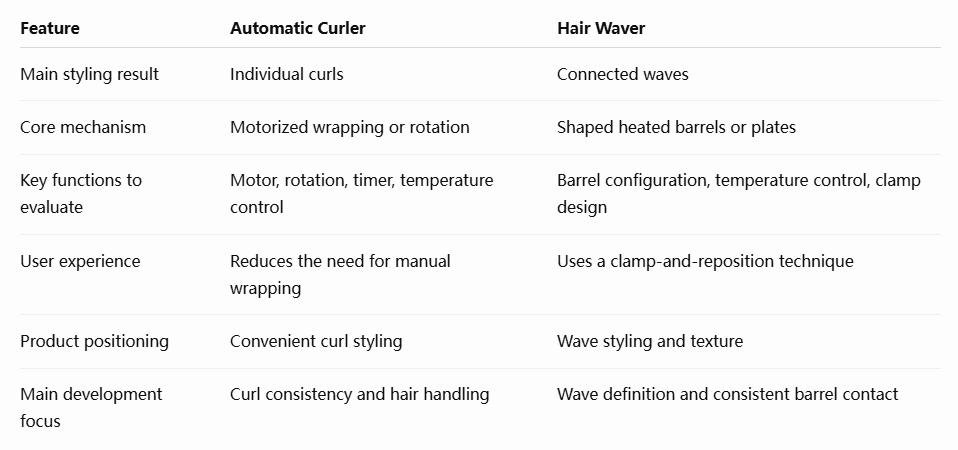
These differences can help brands decide which product better matches their intended market and price positioning.
Consider a hair waver if your target customers:
- Prefer beachy, mermaid-style or defined waves.
- Want a consistent wave pattern across multiple sections.
- Look for a dedicated tool for wave styling.
- Value a straightforward clamping technique.
These are starting points rather than strict customer categories. Actual demand depends on the market, brand positioning, price and competing products.
What Product Features Should You Compare?
The two product types require different engineering priorities.
For an automatic curler, assess:
- Motor performance and rotation consistency
- Hair placement and release
- Anti-tangle design
- Temperature and timer settings
- Ease of cleaning and everyday handling
For a hair waver, assess:
- Barrel shape, spacing and configuration
- Temperature control and heating consistency
- Clamp operation and handling comfort
- Protective design around heated surfaces
- Consistency of the finished wave pattern
What Should Brands Discuss with an OEM/ODM Manufacturer?
Once you select a product category, discuss the project requirements with your manufacturer.
Key points include:
- Product selection: Which existing models match your target market?
- Customization: Can you customize the logo, color, plug, packaging or selected specifications?
- Samples: Can you evaluate the actual styling result and product handling before ordering?
- Compliance: What testing reports and certifications are relevant to your destination market?
- Production: What are the MOQ, lead time and requirements for repeat orders?
Some changes are easier to implement on an existing platform than others. Structural changes, new functions or major heating-system modifications may require additional engineering, testing and development time.
Clear requirements help both sides evaluate feasibility before moving forward.
Final Thoughts
An automatic curler and a hair waver serve different needs. Automatic curlers focus on individual curls and reduced manual wrapping, while hair wavers create connected wave patterns with shaped heated barrels.
For beauty brands, the best decision starts with the target customer and the role each product will play in the collection. Compare the styling results, product features, development requirements and commercial fit before committing to a launch.
 English (UK)
 Español
 Português
 日本語
 Français
 Deutsch
 Русский
 한국어