
What’s the differences between hair-waver-vs-curling-iron? A hair waver and a curling iron both use heat to style hair, but they create different results.
A hair waver forms repeating waves, while a curling iron creates individual curls around a heated barrel. Understanding this difference can help you choose the right tool for your preferred hairstyle.
1. How Do They Work?
Hair Waver
A hair waver uses two or more shaped heated barrels or plates to press hair into a repeating wave pattern.
Users clamp a section of hair, release it and move the tool down the section to continue the pattern. This method creates connected S-shaped waves without wrapping the hair around a barrel.
Fer à friser
A traditional curling iron usually features a single heated barrel and a clamp. Users secure a section of hair, wrap it around the barrel and release it to form an individual curl.
The barrel size and styling technique influence the curl’s shape, from loose bends to tighter curls.
Hair Waver vs. Curling Iron: Key Differences
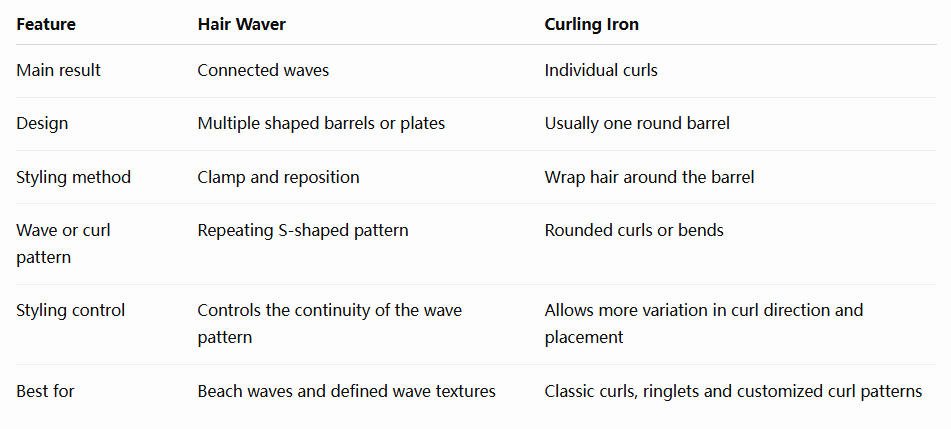
Neither tool is universally better. The right choice depends on the hairstyle you want and the styling technique you prefer.
Which Tool Is Easier to Use?
A hair waver can be easier for beginners who want a consistent wave pattern. Users mainly need to position the tool correctly and align each placement with the previous wave.
A curling iron requires more coordination. Users need to manage the barrel, wrapping direction, section size and release technique.
However, ease of use depends on the specific design and the user’s experience. A clamp-style curling iron may feel more intuitive to some users, while others may prefer the straightforward pressing motion of a waver.
Which Tool Creates More Versatile Hairstyles?
A curling iron generally offers more flexibility when users want to change the shape or direction of individual curls. They can create tighter curls, loose bends or softer waves by adjusting the barrel size and technique.
A hair waver focuses on a more specific result: a repeating wave pattern. Different barrel configurations can produce softer or more pronounced waves, but the tool’s physical design limits the patterns it can create.
If your styling routine mainly involves waves, a dedicated hair waver may be a practical choice. If you prefer several curl styles, a curling iron may offer more flexibility.
Which Tool Should You Choose?
Choose a hair waver if you:
- Prefer connected S-shaped waves.
- Want a consistent wave pattern across multiple sections.
- Like beachy, mermaid-style or more defined waves.
- Prefer clamping rather than wrapping each section around a barrel.
Choose a fer à friser if you:
- Prefer individual curls or ringlets.
- Want to vary curl direction and placement.
- Like classic, bouncy curls or softer curved styles.
- Want more control over the shape of each curl.
Your hair length, texture and preferred styling routine also matter. Before buying a tool, check its design, instructions and suitability for your hair.
Réflexions finales
The main difference between a hair waver and a curling iron lies in the styling result. A waver creates connected waves, while a curling iron forms individual curls with more flexibility in shape and direction.
For consumers, the best choice depends on the look they want. For beauty brands, these differences help define product positioning and build a hair styling range that meets different customer needs.
Looking for hair wavers or curling irons for your brand? Topbeauty supports OEM/ODM hair styling tool projects, including product selection, private-label customization and packaging options. Contact our team to discuss your requirements.
 Français
 English (UK)
 Español
 Português
 日本語
 Deutsch
 Русский
 한국어